

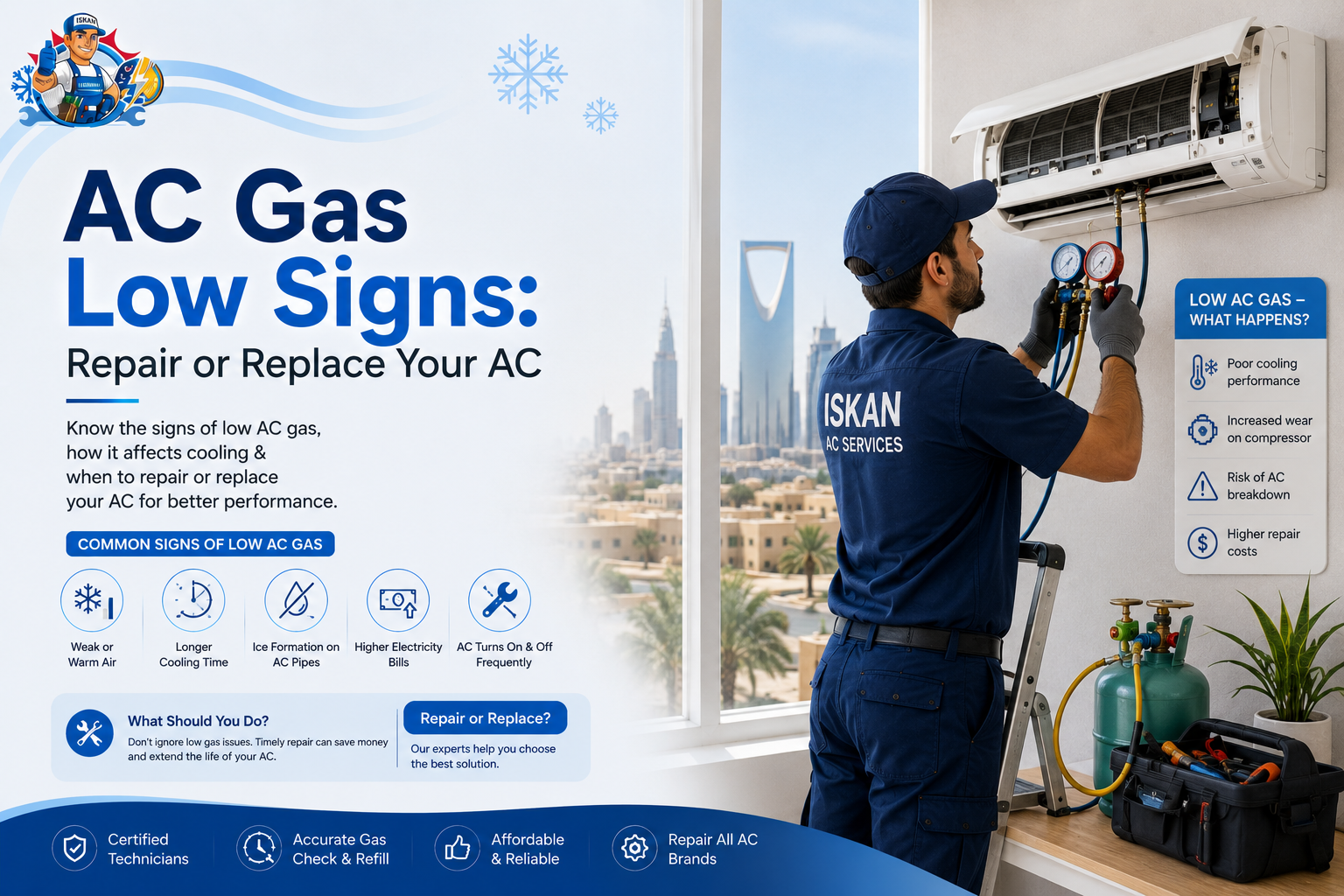
When your AC stops cooling properly, the first thought is usually simple: “Maybe the AC gas is low.” Sometimes that is true. However, low AC gas is not the only reason your air conditioner may blow warm air, run for a long time, freeze up, or increase your electricity bill.
Your AC can also struggle because of a dirty filter, blocked coil, weak capacitor, faulty fan motor, drainage problem, thermostat issue, compressor damage, or poor maintenance. That is why understanding AC gas low signs is important before you spend money on gas refill, repair, or full replacement.
This guide explains how to know if AC gas is low, whether a 7-year-old AC unit is old, what the most common AC repair is, what you can safely check at home, and when to search for a window AC repair shop near me or split AC repair shop near me.
The goal is simple: help you make a smart repair decision without wasting money.
Quick Answer: How Do You Know If AC Gas Is Low?
The most common AC gas low signs are weak cooling, warm air, ice buildup, long cooling cycles, hissing sound, water leakage from frozen coils, and higher electricity bills. If your AC was cooling well before but now takes too long to cool the room, low refrigerant may be one possible reason.
However, one important point matters: AC gas does not normally finish by itself. In most systems, refrigerant moves inside a closed loop. So, when the gas level becomes low, there is often a leak somewhere in the system.
That means only refilling gas without fixing the leak may give temporary cooling. After some days or weeks, the same problem can return.
The Most Common AC Gas Low Signs
Low AC gas symptoms are usually connected to poor heat transfer. Your AC needs the correct refrigerant level to absorb heat from the room and release it outside. When the refrigerant is low, the cooling cycle becomes weak.
Warm Air from the AC
One of the clearest AC gas low signs is warm or less cool air from the indoor unit. The fan may still work, but the air does not feel cold enough.
This can happen because the AC cannot absorb enough indoor heat. However, warm air can also happen due to a dirty filter, outdoor unit blockage, compressor issue, or thermostat problem. So, warm air is a warning sign, not a final diagnosis.
Weak Cooling Even After Long Running Time
If your AC runs for 30 to 60 minutes but the room still feels hot, the refrigerant level may be low. The unit may keep running because it cannot reach the set temperature.
This problem is common when users set the temperature to 18°C or 20°C, but the room never becomes comfortable. In this case, the AC is working harder, using more electricity, and still failing to cool properly.
Ice on the Indoor or Outdoor Unit
Ice formation is another serious sign. If you see ice on the evaporator coil, copper pipe, or indoor unit, low gas can be one reason.
When refrigerant pressure drops, the coil may become too cold. Moisture from the air can freeze on the coil. Once ice builds up, airflow becomes blocked, and cooling gets even worse.
Do not keep running the AC if you see ice. Turn it off and allow the ice to melt. Running a frozen AC can create more damage.
Hissing or Bubbling Sound Near the AC
A hissing sound may point to a refrigerant leak. A bubbling sound can also appear if gas is leaking through a small hole or damaged pipe.
This is not a DIY repair. Refrigerant leakage should be checked by a trained AC technician with proper tools. Guesswork can cause repeated gas refilling and unnecessary cost.
Higher Electricity Bill Without More Usage
If your electricity bill suddenly increases but your AC usage is the same, your system may be working harder than normal. Low gas, dirty coils, blocked filters, or weak components can force the AC to run longer.
Longer runtime means more energy use. So, a high bill is not only a financial problem. It is also a performance signal.
Why Low Gas Often Means a Refrigerant Leak
Many people think AC gas naturally becomes low every season. That is not correct for a healthy system. If the gas level is low, there is usually a leak, poor installation, loose joint, damaged copper pipe, or service valve issue.
So, the smart process is:
First, inspect the system.
Then, find the leak.
Next, repair the leak.
After that, vacuum the line if needed.
Finally, recharge the correct gas amount.
This process gives better long-term results than simple gas top-up.
What Does AC Gas Actually Do?
AC gas, also called refrigerant, is the cooling chemical inside your air conditioning system. It moves through the indoor and outdoor units. During this cycle, it absorbs heat from inside the room and releases that heat outside.
Without the correct refrigerant level, your AC cannot cool properly.
Why Refrigerant Is Not “Consumed” Like Fuel
Refrigerant does not work like petrol, diesel, or cooking gas. It is not burned during AC operation. It circulates again and again inside the sealed system.
So, if your technician says your AC gas is low, ask one important question: “Where is the leak?”
This question protects you from repeated refilling. A professional technician should not only refill gas but also check the reason behind low refrigerant.
How Low Gas Affects Cooling Performance
Low gas affects the pressure balance inside the AC. As a result, the indoor coil may not absorb enough heat. The compressor may run under extra stress. The room may cool slowly. Ice may form. Electricity use may increase.
Over time, low gas can also damage the compressor. Since compressor repair or replacement can be expensive, early diagnosis is important.
AC Gas Low Signs vs Other AC Problems
Not every cooling issue means low gas. Many AC users waste money because they refill gas when the real problem is airflow, dirt, sensor error, or electrical failure.
Here is how to compare low gas with other common AC problems.
Dirty Filter or Low Gas?
A dirty filter blocks airflow. When airflow becomes weak, the AC cannot move enough air across the evaporator coil. This can reduce cooling and even cause ice.
Signs of a dirty filter include weak airflow, dust smell, frequent sneezing, and visible dirt on the filter.
If cleaning the filter improves cooling, the issue may not be low gas. For home users, filter cleaning is one of the safest first checks.
Faulty Capacitor or Low Gas?
A capacitor helps start and run the fan motor or compressor. If the capacitor is weak, the outdoor unit may not start properly. You may hear a humming sound, but the compressor or fan may not work.
Low gas usually causes weak cooling while the system still runs. A capacitor problem may stop the cooling cycle completely because the compressor cannot start.
This repair needs a technician because electrical parts can be dangerous.
Compressor Issue or Low Gas?
The compressor is the heart of the AC. If it is weak or damaged, the AC may blow air but not cool properly.
Compressor problems can look similar to low gas problems. However, a technician can check pressure, ampere load, sound, vibration, and overall system behavior to identify the real issue.
A 7-year-old AC with a compressor problem needs careful cost comparison before repair.
Thermostat Problem or Low Gas?
Sometimes the AC is fine, but the thermostat or sensor is wrong. The AC may stop too early, run too long, or show the wrong temperature.
If the remote setting is correct but the room temperature does not match, the sensor may need checking.
Is a 7-Year-Old AC Unit Old?
A 7-year-old AC is not automatically old. Many AC units can last longer with proper maintenance, correct installation, and normal usage. However, age becomes important when the unit needs frequent repairs, consumes more electricity, makes loud noise, leaks water, or fails to cool during hot weather.
In a hot climate, AC systems often work harder. Dust, high outdoor temperature, voltage fluctuation, poor servicing, and continuous use can reduce performance faster.
When a 7-Year-Old AC Is Still Worth Repairing
Repair may be the better option if the unit has been maintained well, the compressor is healthy, spare parts are available, and the repair cost is reasonable.
For example, if the issue is a dirty coil, clogged drain, capacitor failure, minor sensor problem, or small gas leak, repair may make sense.
Also, if the AC cools well after proper servicing and does not break down frequently, there may be no need to replace it.
When a 7-Year-Old AC May Need Replacement
Replacement may be smarter if the AC has repeated gas leakage, compressor weakness, high electricity consumption, major outdoor unit damage, or poor cooling even after repair.
A unit may also need replacement if repair costs are becoming too frequent. Spending small amounts again and again can become more expensive than installing a newer, more efficient unit.
Repair Cost vs Replacement Value
A simple rule is this: repair is better when the cost is low and the system condition is good. Replacement is better when the repair cost is high and the system is already inefficient.
Before replacing, always ask for a full diagnosis. Sometimes a 7-year-old AC only needs deep cleaning and correct refrigerant charging. Other times, it may have a serious leak or compressor issue.
What Is the Most Common AC Repair?
The most common AC repairs usually include refrigerant leak repair, capacitor replacement, filter cleaning, coil cleaning, drain line cleaning, fan motor repair, and thermostat or sensor replacement.
The exact repair depends on the AC type, age, usage, and maintenance history.
Refrigerant Leak Repair
Refrigerant leak repair is common when users complain about weak cooling, ice buildup, or repeated gas refilling.
A technician should inspect copper pipes, flare joints, service valves, indoor coil, outdoor coil, and connection points. After repairing the leak, the system may need vacuuming and correct refrigerant recharge.
Capacitor Replacement
Capacitor failure is also common, especially in hot weather. A weak capacitor can stop the outdoor fan or compressor from starting.
Signs may include humming sound, outdoor unit not running, AC tripping, or warm air from the indoor unit.
Dirty Coil Cleaning
Dirty indoor or outdoor coils reduce heat transfer. When coils are blocked by dust, grease, or debris, the AC has to work harder.
Deep coil cleaning can improve cooling, reduce pressure on the compressor, and lower energy use.
Drain Line Cleaning
If your AC leaks water from the indoor unit, the drain line may be clogged. Dust, algae, or dirt can block the drainage system.
This is common in split AC units. It may look like a serious issue, but often it is a service and cleaning problem.
Fan Motor or Compressor Diagnosis
Fan motor issues can reduce airflow. Compressor issues can stop cooling completely. These repairs require professional testing.
Do not guess with major parts. Wrong diagnosis can lead to unnecessary replacement.
Can You Repair AC at Home?
You can do basic AC maintenance at home, but you should not handle refrigerant, compressor repair, capacitor replacement, wiring, or sealed system work by yourself.
AC systems include electrical parts, pressure-based refrigerant circuits, and safety risks. A simple mistake can damage the unit or create danger.
Safe AC Checks You Can Do Yourself
Before calling a technician, you can check a few simple things.
Clean or Replace the Air Filter
Turn off the AC. Open the indoor cover carefully. Remove the filter. Wash it gently if it is washable. Let it dry completely before reinstalling.
A clean filter improves airflow and helps the AC cool better.
Check the Thermostat Settings
Make sure the AC is set to cooling mode. Set the temperature to a reasonable level. Check fan speed and sleep mode settings.
Sometimes users accidentally set fan mode instead of cool mode. In fan mode, the AC will blow air but will not cool.
Clean Around the Outdoor Unit
The outdoor unit needs open airflow. Remove leaves, dust, plastic bags, or blockage around it. Do not cover the outdoor unit during operation.
Blocked airflow can cause poor cooling and high pressure.
Check for Water Leakage
Look for water dripping from the indoor unit. If water leaks inside the room, the drain line may be blocked, the unit may be dirty, or ice may be melting.
Turn off the AC if leakage is heavy.
What You Should Not Try at Home
Do not refill AC gas by yourself. Do not open refrigerant lines. Do not touch capacitor terminals. Do not repair wiring without training. Do not keep running the AC if there is burning smell, loud noise, or ice buildup.
For AC gas low signs, professional diagnosis is the safest option.
Window AC Repair Shop Near Me: When to Search
Search for a window AC repair shop near me when your window AC is not cooling, making unusual noise, leaking water, giving a burning smell, tripping the power, or freezing inside.
Window AC units are compact. Many parts are placed close together. That is why proper inspection is important.
Signs Your Window AC Needs Professional Repair
Call a technician if the unit blows warm air, compressor does not start, fan is noisy, water leaks inside, cooling is uneven, or the unit vibrates heavily.
If the AC is old and repair cost is high, ask whether replacement is more practical.
When a Window AC Is Better Replaced
A window AC may be better replaced if it is very old, rusty, inefficient, noisy, or needs major compressor repair.
If the cost of repair is close to the cost of a new unit, replacement can be more sensible.
Split AC Repair Shop Near Me: When to Call a Technician
Search for a split AC repair shop near me when your split AC shows weak cooling, water leakage, gas leakage, ice on copper pipes, outdoor unit noise, indoor fan issue, or error codes.
Split AC systems have indoor and outdoor units connected by copper pipes. A problem in one part can affect the whole system.
Split AC Gas Leak Signs
Split AC gas leak signs include low cooling, ice on the pipe, oily marks near joints, hissing sound, and repeated need for gas refill.
A proper technician should check pressure, leakage points, pipe insulation, flare nuts, and coil condition.
For Riyadh homeowners and businesses, Iskan AC can help inspect low gas symptoms, leakage issues, cooling problems, and repair options with a local service approach.
Indoor Unit vs Outdoor Unit Problems
Indoor unit problems may include dirty filter, blower issue, sensor fault, drain blockage, or evaporator coil dirt.
Outdoor unit problems may include compressor issue, fan motor failure, capacitor damage, condenser coil blockage, or refrigerant pressure imbalance.
A complete diagnosis checks both units.
Repair or Replace? A Simple Decision Guide
Choosing between AC repair and replacement can feel confusing. The right answer depends on the age of the unit, repair cost, cooling performance, energy use, and problem history.
Repair If These Conditions Match
Repair is usually better if:
The AC is less than 10 years old.
The compressor is healthy.
The repair cost is reasonable.
The issue is minor or moderate.
The unit has not had repeated breakdowns.
Cooling improves after servicing.
Spare parts are available.
For example, cleaning coils, replacing a capacitor, fixing a small leak, or clearing a drain line can be worth it.
Replace If These Problems Keep Coming Back
Replacement may be better if:
The AC needs frequent gas refilling.
The compressor is weak or damaged.
Electricity bills are rising every month.
The unit is too noisy.
Cooling is poor after repair.
Major parts are failing.
The AC is near or above 10 years and repair cost is high.
A replacement may cost more at first, but it can save money if your old unit keeps failing.
Final Advice Before You Spend Money
Do not decide only based on one symptom. Warm air does not always mean low gas. Ice does not always mean gas leak. High electricity bill does not always mean replacement.
The best decision comes from proper diagnosis.
Get a Proper AC Diagnosis First
Ask the technician to check filter, coil, airflow, thermostat, capacitor, fan motor, compressor, refrigerant pressure, and leak points.
A good diagnosis should explain the cause, not only the symptom.
Choose a Skilled Local AC Repair Team
Choose a repair service that checks the full system before giving a solution. For local customers searching for reliable inspection, Iskan AC can be considered for AC gas low signs, split AC repair, window AC repair, and repair-or-replacement guidance.
Frequently Asked Questions
1. How do I know if my AC gas is low?
Common signs include warm air, weak cooling, ice on the coil or pipe, hissing sound, long running time, and higher electricity bills. However, a technician should confirm it with proper pressure testing.
2. Does AC gas finish naturally?
No. In a healthy sealed system, refrigerant should not finish like fuel. If gas is low, there is usually a leak or installation issue.
3. Can I refill AC gas myself?
No. Refrigerant work should be done by a trained technician. It requires tools, safety knowledge, and correct refrigerant handling.
4. Is a 7-year-old AC unit old?
A 7-year-old AC is not automatically old. If it is well maintained and the compressor is healthy, repair may still be worth it. If it has repeated problems, replacement may be better.
5. What is the most common AC repair?
Common AC repairs include capacitor replacement, refrigerant leak repair, coil cleaning, filter cleaning, drain line cleaning, fan motor repair, and thermostat sensor repair.
6. Why is my AC running but not cooling?
Possible reasons include low gas, dirty filter, dirty coil, faulty capacitor, compressor issue, thermostat problem, or blocked outdoor unit airflow.
7. Why is there ice on my AC pipe?
Ice can happen because of low refrigerant, dirty filter, blocked airflow, or dirty evaporator coil. Turn off the AC and call a technician if the problem repeats.
8. Should I repair or replace my AC?
Repair if the issue is minor, the unit is not too old, and the repair cost is reasonable. Replace if the AC is inefficient, breaks down often, or needs expensive major repairs.
9. When should I search for a window AC repair shop near me?
Search when your window AC has weak cooling, water leakage, loud noise, burning smell, compressor issue, or repeated tripping.
10. When should I search for a split AC repair shop near me?
Search when your split AC has low cooling, gas leak signs, water leakage, ice buildup, outdoor unit noise, error codes, or compressor problems.
